

Coordination is King
The Next Battle in Media Is Over Who Controls the Moment of Choice


At least once during every Viacom earnings call, the late Sumner Redstone would intone “content is king” in his thick, Bostonian accent.
He was mostly right during the 1990s and 2000s, but over the last 5–10 years, the needle has decisively swung the other way. Almost all the value created in media over that period has accrued to companies that distribute content to consumers, such as YouTube, TikTok, Meta, Steam, Netflix, and Spotify. Those that control content or package it have largely seen value stagnate or decline.
Below, I’ll argue that it is not distribution alone that won, but the coupling of distribution and coordination—influence over consumers’ choices. That distinction matters because AI threatens to partially uncouple coordination from the distributors that control it today. Who owns this coordination layer is shaping up to be one of the biggest battles in media over the next decade.
Tl;dr:
The content-vs-distribution debate has raged in media for decades. In recent years, almost all the value created in media has accrued to those who distribute content, not create or package it.
But what really mattered was the coupling of distribution with coordination, namely controlling the moment of consumer choice. Coordination increases bargaining power—and value capture—both by enhancing scale and enabling platforms to allocate attention advantageously.
Since distribution and coordination are usually coupled in media—the entry price of controlling coordination has historically been controlling access to supply—it is hard to tease apart the value of coordination alone. The best analogy to understand the value of pure coordination is Google Search, which arguably created ~$3 trillion of Alphabet’s $4+ trillion market value by solving the web’s coordination problem.
AI may partially uncouple distribution and coordination in media by introducing a new intermediary layer. Chatbots and agents could offer a much better solution than platform-specific search and recommendations for several reasons: natural-language interaction; cross-platform discovery; much deeper personal context; and more aligned incentives.
There’s growing evidence that consumers are increasingly leaning on AI to help them organize information, and entertainment is likely no different.
Video coordination is particularly ripe for disintermediation by AI and is shaping up to be the biggest battleground. For the largest incumbents, like Netflix, Amazon, and YouTube, that will accelerate their efforts to become platforms and, potentially, the front door to all TV. Smaller streamers may increasingly migrate toward wholesale models as the scale necessary to compete in streaming ratchets higher.
Most pundits focus on AI’s potential to lower content costs, but AI threatens today’s consumer platforms from both directions: it makes supply more abundant beneath them while potentially creating a new decision layer above them.
There is no question that coordination will get more valuable as supply approaches functionally infinite. The question is who will own it.
Distribution Won—Or Did It?
Every company cares about relative bargaining power along its value chain. That’s why “commoditize your complements” is almost a religious edict in Silicon Valley.
Relative bargaining power is more important in media than most sectors.
It’s especially important for media companies for two reasons: media no longer has much secular growth—a rising tide is not lifting all boats—so most increases in value come from redistribution along the value chain; and very few players are fully vertically integrated, making most media companies highly interdependent. Film studios rely on creatives, production vendors, theaters, streamers, and device platforms; labels rely on creatives, DSPs, social platforms, satellite and terrestrial radio, retailers, live-event companies; and so on.
In media, the debate about bargaining power is often distilled into “content” versus “distribution,” that is “those who make the stuff” vs. “those that deliver the stuff.” That is a blunt simplification of the media value chain, but it’s still useful because it describes the two primary control points where bargaining leverage might accrue. Plus, most participants either fall cleanly into one bucket or, if they don’t, still organize themselves this way internally. For instance, Comcast (currently) owns both content (NBCUniversal) and distribution assets (Xfinity), but they are operated almost entirely separately (sufficiently so that Comcast recently announced plans to spin NBCU off). Even within NBCU, the content (Universal Pictures) is run separately from distribution (Peacock).
The content-versus-distribution debate has raged for decades in media. Redstone’s line that “content is king” was self-serving, since Viacom was mostly a content company, but for a long time it was also mostly right. Content is highly differentiated (consumers are not indifferent between Love Island and Game of Thrones, even if they portray similar power dynamics), but distribution generally is not. As a result, distribution tends to have market power only when it operates within a concentrated market structure—a monopoly, duopoly, or rational oligopoly.
Take pay TV. When cable systems first arose as natural monopolies in the 1980s, cable was the only game in town and had the leverage. The Cable Act of 1992 established must-carry and retransmission-consent rules, handing leverage back to content owners. Then satellite emerged as a viable competitor to cable, shifting even more power toward content. By the late-2000s, growth in pay TV subscribers began to slow and distributors became less willing to accept large affiliate fee increases, so it became more common for cable networks to “go dark” when contract renewals hit an impasse. But it was always the distributor who blinked first because the risk of a prolonged outage was asymmetrically in favor of the networks.1 In those days, Redstone was right.
Redstone was mostly right during the 1990s and 2000s, but the pendulum has decisively swung toward distribution over the last decade.
In more recent years, however, the debate appears to have been resolved decisively in favor of distribution. Almost all of the value created in media over the last 5–10 years has been captured by companies that distribute content to consumers.
In Figure 1, you can see that the enterprise value of a representative set of media companies (defined broadly) roughly doubled from 2018 to 2025. Virtually all of that value went to digital consumer platforms (for lack of a better term) like Meta, Netflix, Spotify, YouTube, TikTok, Valve/Steam, and Roku. The other segments shown in the chart either declined in value—media conglomerates, MVPDs, and broadcasters—or were more or less a rounding error2—newspapers and music labels.
Figure 1. Almost All the Value Has Flowed to Companies That Control Consumer Relationships
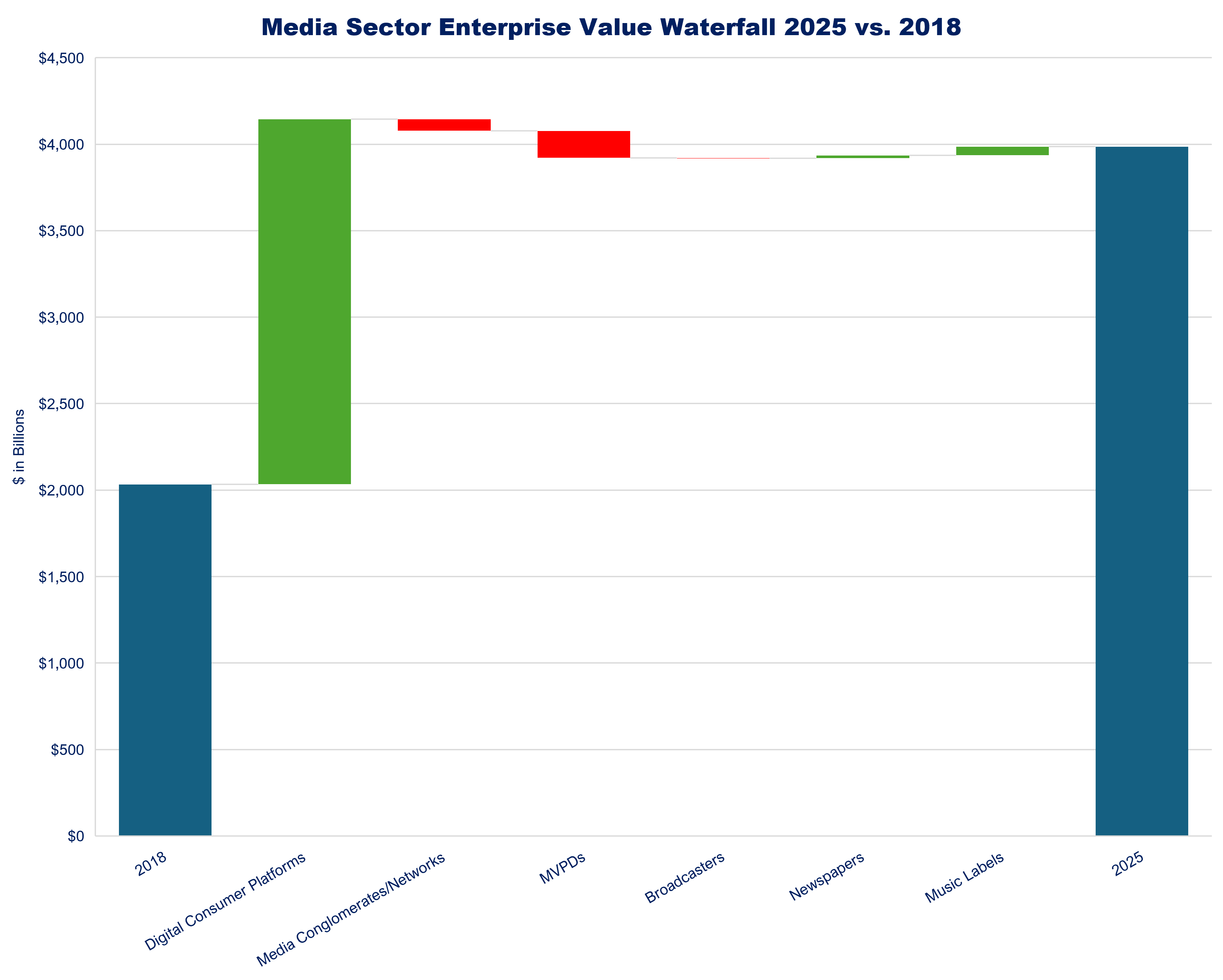
Note: This chart tracks a representative subset of media companies to calculate total “media sector” enterprise value. It attempts to compare a similar set of assets at both endpoints. For instance, 2018 includes Disney and Fox and 2025 also includes Disney and Fox, even though most of the former Fox assets are now owned by Disney. Similarly, 2018 includes WarnerMedia and Discovery, while 2025 includes Warner Bros. Discovery. “Digital Consumer Platforms” includes Meta, Netflix, Spotify, YouTube, TikTok, Valve/Steam, and Roku. “Media Conglomerates/Networks” includes Disney and Fox, WarnerMedia and Discovery/WBD, CBS and Viacom/Paramount, NBCUniversal, Lionsgate/Starz, and AMC Networks. “MVPDs” includes Comcast’s communications business, Sky, Charter, DirecTV, Dish/EchoStar’s video-distribution assets, and Altice/Optimum. “Broadcasters” includes Nexstar/Tribune Media, Sinclair, Tegna, Gray Television, and E.W. Scripps. “Newspapers” includes The New York Times, News Corp, Gannett, and Lee Enterprises. “Music Labels” includes Universal Music Group, Warner Music Group, and Sony Music/EMI Music Publishing. Source: Morgan Stanley, The Mediator.
Let’s pause here for a second and think about what this chart means. Imagine that for the last decade you’ve worked as an analyst at a mutual fund or hedge fund responsible for investing in the broader internet and media sector. You cover 50 companies across internet, media conglomerates, cable, music, radio, TV broadcasters, and live experiences. Every day, you got up and scanned for relevant news items and analyst reports. You built and updated your models. You chased down industry contacts or paid to access them through expert networks. You went to conferences and sat in group meetings, listening for the slightest change in tone from the conference two weeks prior. You went to “idea dinners” to compare your best long and short ideas with your peers. You tried to time the right entry points and prepared pitches to your portfolio managers.
Instead of doing all that, you could have followed one rule and taken the rest of the decade off: buy the companies that control the consumer and short the ones that don’t.
This is Ben Thompson’s Aggregation Theory at work. As supply becomes abundant, the best strategic position is to control scarce demand. But how do you control demand?
It is not distribution alone. It is the combination of distribution and coordination.
