Fan Surplus, HYBE, and the Science of Fandom
Why the Future of Media is Selling More to Fewer
The subtitle of this post is a nod to The Long Tail: Why the Future of Business is Selling Less of More, by Chris Anderson. Written more than 20 years ago, it was ahead of its time. A lot of consumption has shifted into the tail. But for media companies that want to grow, the future of media is selling more to fewer.
I recently wrote a post called What if All Media is Marketing? The idea is that if GenAI collapses the cost to make content, content pricing and profits will also collapse, so the only way to make money will be to sell complements—products and services adjacent to the content itself. Content goes from primary profit center to top-of-funnel.1
After that post, the question I got back most often was: “OK, but how do you develop successful complements?” As I explain in this follow up, the critical lens to use, and the question that every media company should be asking, is: what would my most dedicated fans pay more for? Said differently, the bottom of a funnel is smaller than the top. Traditional media companies need to shift their focus from reaching the many to superserving the few(er).
Tl;dr:
Let’s coin the term fan surplus. If consumer surplus is the difference between consumers’ willingness-to-pay and the market price, then fan surplus is fans’ excess willingness to engage more deeply, more frequently, and across more dimensions with the objects of their fandom.
The media industry’s biggest necessity and opportunity is to capture fan surplus.
Media derives revenue by monetizing consumer attention and engagement. The bad news is that attention is finite and no longer growing. As GenAI advances, increasing time spent becomes a zero-sum game that traditional media companies can’t win. The good news is that engagement is unbounded—especially from the most ardent fans.
Historically, media companies had limited tools to capture fan surplus. Pre-internet, distribution was one-to-many, with no way to tailor products or accurately measure consumption and no knowledge of its consumers. An artifact is that most media products are still one-size-fits-all, regardless of degree of engagement: one CPM, one price for an album or game, one price for a movie ticket. Many media companies also still cling to a reach mentality.
Today, media companies have the tools. They can create effectively infinite versions of media products; gather granular user data; and monetize through built-in payment rails. GenAI will enhance this toolset.
To understand what it means to systematize fandom in practice, look to South Korean music label HYBE. It builds groups from the ground up to maximize fandom; owns its own fan communications, commerce, and concert platform (Weverse); and uses the associated data to inform product development, marketing, release schedules, etc. As a result, it derives a much higher proportion of its revenue from “fandom” than peers.
Today, most media companies manage fandom, but they don’t foster it, cultivate it, or, for the most part, monetize it. In the future, they’ll have to.
What is Fan Surplus?
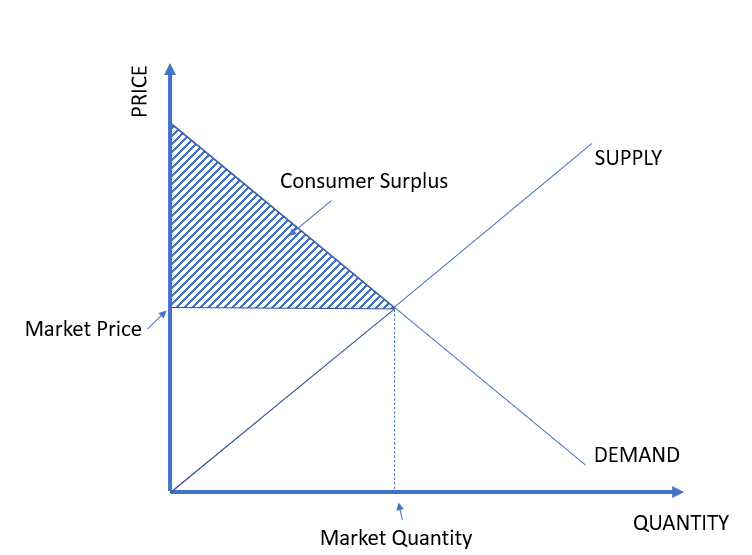
Consumer surplus is the term economists use to describe the excess value that accrues to the consumers that are willing to pay more than the market price. Consider Figure 1. Other than edge cases where demand is entirely inelastic, demand curves slope down, like this one. The market-clearing price occurs where supply meets demand. Since the demand curve slopes down, that means all the demand to the left of the market price represents consumers whose willingness-to-pay (WTP) was higher.
Let’s take demand for lattes and assume that the market clearing price is $5. There may be some who would pay $12, some $10, some $7, and so on. The difference between their WTP and what they actually pay is consumer surplus.
Figure 1. Consumer Surplus is What Accrues to All the People Who Would’ve Spent More
Source: Every microeconomics textbook ever.
“Fan surplus” is excess willingness of fans to engage more deeply, more frequently, and across more dimensions with their favorite characters, artists, teams, or stories.
Strictly speaking, consumer surplus arises because some people would pay more than others for the same thing. I’ll coin a related concept, which I’ll call fan surplus: excess willingness (or eagerness) of fans to engage more deeply, more frequently, and across more dimensions with their favorite characters, artists, creators, teams, or stories.
Extracting fan surplus is the industry’s biggest necessity and opportunity.
The media industry’s greatest necessity and opportunity is to capture this surplus by giving the most ardent fans more of what they want. It’s a necessity because media attention is no longer growing; it’s an opportunity because fans are willing to engage, and pay, more.
Let’s discuss each.
The Attention Problem
Every time I give a presentation, I make the point that ultimately the media business is about monetizing consumer attention and engagement. When you think about it, this is not true for most businesses. The price you pay for a steak doesn’t reflect how many times you chew it and the cost of your car is not based on the length of your commute. In the case of media, however, the revenue a business generates is directly or indirectly correlated with the amount of time consumers spend (especially for advertising-supported businesses). So, the amount of available attention is a structural constraint on the size of the business. And the problem is that there isn’t a lot more attention to go around.
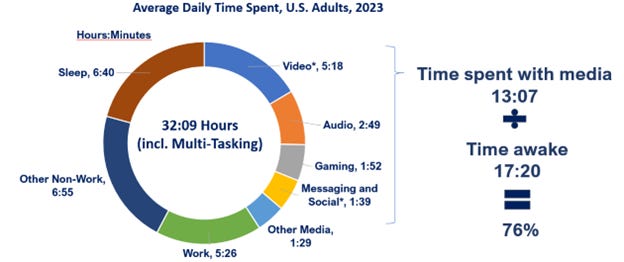
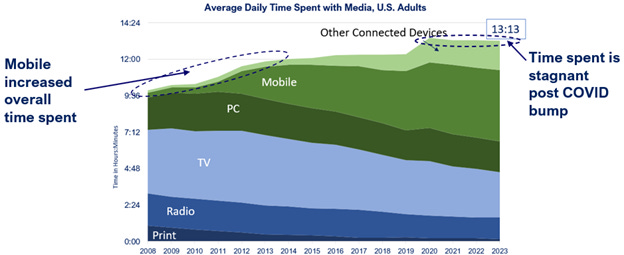
As shown in Figure 2, in the U.S., the average adult spends more than 75% of waking hours with media, which is probably pretty consistent with other advanced economies. Figure 3 shows a time series of time spent with media (albeit from a different source). Time spent grew with the advent of a major new form factor—mobile—then leveled off. Then it got a bump around COVID, but it has been stagnant since.
Figure 2. The Average U.S. Adult Spends 13 Hours Per Day With Media, >75% of Waking Time
Note: * Social video is included in Messaging and Social. Source: Activate.
Figure 3. Time Spent with Media is No Longer Growing in the U.S.
Source: eMarketer.
Is there a reason to be hopeful that time spent with media ever climbs meaningfully again? Perhaps. Maybe self-driving cars proliferate and free up commuting time for media consumption. Or maybe AI is so good at automating tasks that it increases leisure time. But both are a tough bet. It seems just as likely that new competitors for content consumption time arise, too. For instance, as the barriers to content creation fall, it’s possible that the biggest competitor for time spent consuming content will be time spent creating it.
It’s tough to bet that time spent with media will grow materially. As GenAI advances, increasing time spent becomes a zero-sum game that traditional media companies can’t win.
As GenAI continues to lower the barriers to entry, the competition for time will get ever more intense. Call it AI slop or brain rot or whatever pejorative you want. It will, almost undoubtedly, draw away some of consumers’ attention.
So, for traditional media companies, increasing time spent is a zero-sum game that they can’t win.
The Engagement Opportunity
If attention is no longer growing, what about engagement? There isn’t a consensus definition of engagement, but here’s a simple one: engagement is the depth, quality, and intensity of attention. And here’s the good news. While attention is finite and, as far as we know today, tapped out, engagement is unbounded.
The other good news is that consumers can have extraordinarily strong feelings for media products and artists, so engagement can be very deep, very high quality, and very intense.
The bad news: attention is finite. The good news: engagement is unbounded.
Fans Have a Very High Willingness to Pay
It is self-evident that people can get very fanatical about their favorite musical acts, movies, books, actors, or TV shows. We’ve all seen the iconic footage of hysterical screaming girls when The Beatles landed at JFK or appeared on the Ed Sullivan Show. If you’ve been to a Harry Styles concert or ComicCon or seen what happens when you cross Zack Snyder fans, you’ve experienced it personally. People go into debt to see Taylor Swift. They get tattoos of their favorite media properties. (And I won’t even bring up sports, which is on another level.) But it’s worth spending a moment to understand why this happens and why it matters.
Intrinsic vs. Extrinsic
In the past, I’ve written that the value of all goods and services falls somewhere on a continuum between functional and emotional, but extrinsic and intrinsic may be a better framing.
An extrinsic good solves a problem or minimizes friction. The value of a hammer, 9-volt battery, or athletic sock is almost entirely extrinsic. An intrinsic good enables you to feel something. It satisfies some psychological, emotional, or social need or reinforces identity. Like other luxury goods, a Hermès Birkin bag has a modicum of extrinsic value—you can carry stuff in it—but that’s also true of a canvas sack. Its value is 99.999999% intrinsic. Cars fall somewhere in the middle, with budget cars closer to the extrinsic end and luxury cars closer to the intrinsic end.
The Value of Media is Mostly Intrinsic
Media and entertainment products are also almost entirely intrinsic goods. Sometimes they fulfill an extrinsic function (like teaching you about the history of The Ming Dynasty, giving you the day’s headlines, or helping you change the battery in your key fob), but people primarily consume songs, movies, TV shows, games, and novels to feel an emotion (laughter, catharsis, escapism, excitement, surprise); a deeper connection with other people (like your family or chosen social group); or bolster their identity (feel superior, reinforce beliefs, reinforce self-image, etc.).
Intrinsic Goods are Much More Likely to Inspire Fandom
For obvious reasons, intrinsic goods are far more likely than extrinsic goods to inspire intense fandom—and higher willingness to engage and spend.
Since intrinsic goods are bound up with identity and emotion, the intensity of engagement they inspire translates directly into economic behavior. People don’t just like their favorite media properties—they identify with them. (You may own a hammer, but you are a Beyoncé fan. Your love of Beyoncé is part of your identity.) When identity is on the line, WTP—and, more loosely, willingness-to-engage—is much more elastic. The more something reflects who we are, the less we treat it as a discretionary expense and the more as self-expression or belonging. And people will pay a lot for that.
Consulting firm Activate shows this empirically. According to its analysis, super users of media represent about 1/4 of the U.S. adult population. They spend almost 19 hours per day with media (which sounds high, but reflects multitasking) and represent 46% of video spend, 79% of gaming spend, and 81% of music spend (Figure 4).
Figure 4. Super Users Drive the Media Economy
Notes: Spend reflects spend on software and services, not hardware. Source: Activate.
So, there is clearly fan surplus if media companies offer appealing products for superfans. But most media companies aren’t currently set up this way.
Most Media is Still One-Size-Fits-All
Pre-internet, media was analog and one-way. Media companies delivered the same thing to everyone, for a few reasons:
Media technologies were one-to-many (point-to-multipoint) and it wasn’t technically possible to deliver different versions to different people. The only option was to deliver the same radio or TV broadcast, cable or satellite signal, edition of the newspaper, or movie to everyone.
The only thing measurable was reach, so there was no value in differentiation. With no return path, the only measurement possible at scale was just exposure: viewers, listeners, readers, or buyers. (And, even then, measurement was often crude and imprecise, based on small samples or (even worse) surveys.) If you can’t measure different audiences, you also can’t sell them to advertisers, so there’s little incentive to tailor products.
Providers knew nothing about their customers. For the same reason, media companies knew almost nothing about their customers. There was no user “data” as we know it today. They didn’t know who they were, their profiles, behaviors, or preferences.
As a result, media business models formed around one-size-fits-all solutions, whether serving the most engaged, ardent fan or casual, passive consumer. In most cases, those models persist today. And many media companies cling to a reach mentality (meaning that they measure and reward reach, not engagement). For instance:
Advertisers pay one CPM for all viewers, listeners, or readers.
All movies cost the same, tiered only by age.
All video games, books, songs, and albums cost the same.
Streaming services have a few tiers, distinguished by features.
Today, media companies have the tools to superserve fans. Almost all media is distributed on digital, two-way networks, So, the circumstances I described above have changed in every way:
Digital, point-to-point networks enable infinite versioning. Now, it’s possible to deliver different versions and different products to different people. Not that you’d want to, but it’s increasingly possible to personalize everything.
It’s also possible to have different entitlements. The existence of a return path means you can verify who is entitled to get what.
Granular data and measurement are accessible. For media companies with D2C channels, they can now observe and measure behavior down to the individual level—who watches, listens (and re-watches and re-listens), likes, skips, buys, shares, or churns. Among other things, this can inform product development, pricing, and marketing.
Payment rails are in place. The infrastructure for consumers to seamlessly, frictionlessly purchase is now ubiquitous, through global app stores and digital wallets.
OK, so it’s now possible to tailor products for fans. What would it look like for a media company to be designed around building and monetizing fandom? Glad you asked.
HYBE and the Science of Fandom
Outside music industry circles, HYBE Corporation is not well known in the U.S. (even if some of its acts are). HYBE is a South Korean music label, talent management, and fan platform company. Its best-known act is BTS, the global phenomenon that is arguably most responsible for the growing popularity of K-pop around the world. Other acts include TOMORROW X TOGETHER, SEVENTEEN, and many others. (They really like ALL CAPS for some reason.) It is also expanding globally. In 2021, it bought Scooter Braun’s Ithaca Holdings to form HYBE America, and last year formed HYBE Latin America.
Other media companies can’t replicate everything that HYBE does, nor should they, but it is one of the best examples of what it means to systematize the creation and monetization of fandom.
HYBE has developed what you could call the full “fandom stack.”
Most of the groups are formed from the ground up, with members carefully selected for talent, group chemistry, attractiveness, and fan accessibility—in other words, to maximize fandom. (One example of this fan focus: Initially, HYBE founder and chairman Bang Si-hyuk envisioned BTS as a hip hop crew, but then shifted to K-pop when he recognized the size and engagement of the fan base.)
This practice isn’t new. The Monkees, Menudo, NKOTB, Backstreet Boys, and the Spice Girls were all created by producers. But HYBE has elevated it to an almost industrialized system. They have large pools of trainees, who may train for years, and teams that oversee every element in cultivating talent: vocal lessons, songwriting, choreography, styling, and media training.
It has become common in recent years to form new groups by choosing the final members through survival shows, in which viewers vote for their favorites. This engages fans from the very beginning, even before the first song is released.
Group members are encouraged to be authentic and accessible on social, frequently posting photos and vlogs, live streaming everyday moments, and sharing their own vulnerabilities.
Groups are not just musical acts but IP generators and entire worlds. BTS, for instance, has constructed a world called Bangtan Universe (BU). It features characters named after the real BTS members, sometimes portrayed by them, but living fictional lives. The BU world is non-linear, woven into the group’s albums and videos, as well as short films, books, webtoons, and video games.
Maybe most important, HYBE has created a fan app called Weverse that is available globally and includes exclusive videos, live streams, digital and physical goods (through Weverse Shop), social features (fan-to-artist and fan-to-fan), and digital concerts. According to the company, at the end of 2024, the Weverse app had 150 million lifetime downloads. (It supports both HYBE and third-party artists; as of 2023, 90% of the 117 artists on the platform were from labels other than HYBE.)
Owning Weverse also gives HYBE rich insights into fan behavior, which it uses to develop new products, decide where to tour, when to schedule releases, and construct marketing campaigns.
The company creates products for superfans. For instance, every BTS release comes in multiple collectible formats. MAP OF THE SOUL: 7 had four versions, each with unique photobooks and digital items. Some fans buy every version to round out the set or buy multiple copies to get different digital collectibles.
HYBE also pioneered the idea of official fan club subscriptions (usually priced ~$25 annually, but with higher-priced tiers). Perks include exclusive content or AMAs, pre-sale tickets, and exclusive merchandise. The BTS fan club (“BTS ARMY”) is estimated to have millions of members.
The proof is in the pudding, of course, but one way to test whether these efforts are meaningful is to analyze the percentage of HYBE revenue that comes from activities other than recorded music, which we could broadly call “fandom revenue.”
You can see this in Figure 5, which compares HYBE to Universal Music (UMG) and Warner Music (WMG) for fiscal 2023 (the last year HYBE reported a detailed revenue breakdown). (For UMG and WMG, I excluded their UMPG and Warner Chappell Music publishing businesses, respectively, since HYBE doesn’t have a large publishing business.)
In 2023, besides recorded music (45%), HYBE’s other sources of revenue were Concerts (16%), Advertising/Appearance/Management (7%), Merch and Licensing (15%), Content (Video) (13%), and Fan Clubs (4%). So, more than half its revenue came from “fandom,” a much larger proportion than its major label peers.
Figure 5. HYBE Generates More Revenue from “Fandom” than Peers
Notes: For HYBE, “Fandom” revenue includes Concerts, Advertising/Appearance/Management, Licensing, Content (Video), and Fan Clubs. For UMG, totals exclude Music Publishing revenue and “Fandom” revenue comprises Merchandising & Other. For WMG, totals exclude Music Publishing and “Fandom” revenue includes Artist services and expanded rights and Licensing. Source: Company reports, The Mediator analysis.
This is not to say that every media company should emulate every aspect of the HYBE model. If done poorly, such overt efforts to cultivate and monetize fans may feel manipulative and turn fans off. A lot of talent would bristle at, or outright reject, so much oversight and control of their work. Also, K-pop lends itself to especially fervent fandom. Not every media IP has the same monetization opportunities.
Western media has ceded social and commerce to third-party platforms. Why isn’t Disney+ the fan hub for all things Disney?
But it shows what’s possible. Weverse is especially important. Western media companies have completely ceded social, commerce, and fan interaction to third-party platforms, like YouTube, Instagram, TikTok, Spotify, Amazon, Twitter, Discord, Reddit, etc. Through Weverse, HYBE has created an extremely powerful flywheel that enables it to both create and monetize new products and receive data from its fans. Some big media companies could do the same—for instance, why isn’t Disney+ the fan hub for all things Disney?
Why Now?
Across the broader media landscape, you see sporadic efforts to capture fan surplus by offering fans additional products, services, and features.
The mobile gaming business model revolves around the tiny proportion of users (or “whales”) that generate the vast majority of revenue. According to a 2016 study by marketing firm Swrve, half of all mobile games revenue comes from 0.19% of users. In Candy Crush-developer King’s last earnings report as a public company, it disclosed that in 2015 it generated over $2 billion of revenue, but only 7.4 million out of its 494 million active users spent anything at all, or 1.5%. Disney has elevated price differentiation to a science at the parks (sometimes at the cost of frustrated visitors and bad press). Ticketmaster now dynamically prices “Official Platinum” seats for some shows based on demand and Live Nation Premium bundles extra amenities and services on top of concert tickets. You could also argue that content windowing—effectively charging different prices depending on when the product is available—is a blunt form of price differentiation aimed at extracting fan surplus.
Capturing fan surplus doesn’t need to seem exploitative or exclusionary, it just needs to give fans more of what they want.
But these examples are the exceptions, not the rule. For most media companies, fan surplus is largely untapped. Capturing it doesn’t need to appear exploitative or exclusionary. It can just offer fans more of what they want. Broad categories include:
Access: direct interactions (like AMAs and live streams), exclusive events, fan clubs, early access.
Exclusive content: behind the scenes, director’s cuts, alternative endings, etc.
Identity and status: merch, digital goods (badges, skins, collectibles), status signals (verified superfan tags, etc.), fan loyalty points.
Participation and input: voting, story input, crowdsourced input (naming contests).
Fan creation: remixing tools and assets, UGC marketplaces.
Collections: limited edition drops, tokenized collectibles.
Community: fan-to-fan spaces (official forums, Discord-style servers).
The urgency to figure this out is increasing, for reasons I cited above.
Attention isn’t growing. People’s attention is already tapped out. As GenAI lowers barriers to creation, the competition for attention will only intensify. The only way for traditional media to grow is to get fans to spend more.
Content margins will likely compress or collapse. This was the impetus for writing this post. As I argued in What If All Media is Marketing?, if GenAI dramatically reduces the cost to create content, the logical conclusion is that profit margins on content will compress or collapse and the business model of content creation will change. It will become top-of-funnel to sell something else. At that point, the “selling something else” will go from nice-to-have to do-or-die. Media companies will need to become adept at that something else.
GenAI will enable new ways to capture fan surplus. Just as the advent of the internet made new things possible in media, GenAI will too. It will be possible to customize or personalize content, communications, and marketing at scale. It will also make it easy for fans to remix and reimagine their favorite IP. That will provide both a way to deepen engagement outside of the normal content cycles and maybe another business opportunity for IP owners.
Today, most media companies try to manage fandom. They don’t foster it, cultivate it, or, for the most part, monetize it. In the future, they’ll have to.
That may sound out there, but this has already happened in media with low barriers to creation. In mobile gaming, for instance, game development costs collapsed, pricing went to free, and developers now make all their money selling complements to gameplay, like in-game cosmetics; power ups, upgrades, or skips to accelerate progress; digital goods and collectibles, etc.