

What If All Media is Marketing?
The Logical Conclusion of Plummeting Creation Costs


There are a lot of open questions about how GenAI will affect the media business (some of which I outlined in How Far Will AI Video Go? and a recent presentation). Most important, we don’t know how good the technology will get or to what degree consumers will accept it, and for which use cases. There are still critical legal questions around the way that AI models are trained. The copyrightability of AI-assisted or enhanced content hasn’t been tested at scale either.
But we can chart the general direction and think through the possible consequences. So, it’s worth asking: if over the next 5-10 years GenAI reduces the cost of content creation as much as the internet brought down the cost of content distribution, what happens? The short answer: most content won’t be profitable and value will shift to complements.
Tl;dr:
Strictly speaking, the internet disrupted media distribution. Content creation businesses only felt the indirect, upstream effects.
GenAI will deliver a direct hit. While a patchwork of technologies has chipped away at the barriers to creation too in some media formats—DAWs and sample marketplaces in music; cheaper cameras and editing software in video; free gaming engines, etc.—GenAI looks poised to completely collapse barriers to creation across media.
What happens then? Here’s a common pattern. When barriers collapse in a market, supply explodes, consumer price sensitivity increases, prices migrate toward marginal cost, and all the value shifts to the scarce complements. This has happened in markets as diverse as food, stock trading, digital photography, PCs, consumer electronics, and many others. In all cases, the commoditized product becomes a loss leader, customer acquisition cost (CAC), or, at best, marginally profitable and value shifts elsewhere.
If the same pattern plays out in media, most content may cease to be a profit center. Instead, it will become top-of-funnel to something else. Media will become marketing.
To be clear, there’s a difference between “media sells marketing” and “media is marketing.” Today, content is the product and one way it monetizes is by renting out the attention it generates—selling advertising. In this new model, content is the cost and the only sustainable profits will be for media companies to own the complements themselves.
This may sound extreme, but connecting some dots, we can see that this pattern has been happening in media for years. Prices are deflating. Consumer price sensitivity is increasing (see: struggling box office). Content is increasingly top-of-funnel for complements: Amazon and Apple monetize video through higher customer spend or ecosystem lock-in; recorded music is effectively promotion for concerts; mobile gaming is free-to-play and instead monetizes status or community; and the biggest creators (YouTubers, podcasters) are now making more selling snack foods, beverages, merchandise, courses, or live events, than the direct monetization of the content they create.
As this continues to play out, media companies will have to re-orient their businesses. What used to be called “ancillary” sales will now be primary. Fandoms, communities, franchises, merchandise, and live experiences will be the economic engines, not the content itself.
They will need to: 1) own the tried-and-true complements where possible—consumer products, live events and experiences, and transmedia exploitation; 2) create new scarce complements (such as those built on status and exclusive access); and 3) bundle these scarce complements to increase consumer lock-in.
Some media companies already think about content franchises holistically (Disney being the canonical example). Most don’t.
It’s an opportunity for media companies that can position themselves accordingly. For others, it will be a hard pivot.
The Internet Disrupted Media Distribution
Sometimes people say that "the internet disrupted music” or “Netflix disrupted Hollywood.” If we’re going to be precise, neither is correct. The internet has not disrupted content creation businesses. The reason lies in the distinction between direct and indirect disruption.
Direct disruption occurs when a new competitor shows up with a cheaper, less performant product that is “good enough” for some of the incumbents’ customers and the incumbents can’t respond due to internal constraints. Indirect disruption occurs when one part of an ecosystem or value chain is disrupted and other parts feel the effects.
The internet disrupted distribution directly and content creation indirectly.
The difference is important to us because, for the most part, the internet disrupted media distribution directly and content creation indirectly. Consider music and video as two examples:
Music: iTunes and digital distribution disrupted traditional music distribution directly, especially music retailing. Tower Records, Virgin Megastore, and HMV went bankrupt. Major labels were adversely affected indirectly. They acquiesced to Apple’s demand to let iTunes unbundle albums into singles, which resulted in people spending less on recorded music. That hurt everyone in the value chain, including labels. But the labels were upstream from the disruption itself.
Video: Same thing goes for Hollywood studios. The advent of streaming, namely Netflix, directly disrupted video distribution: TV stations, pay TV distributors (cable, telecom, and DBS), movie theaters, and home entertainment retailers. TV stations have been slammed; DBS has been demolished (unlike cable and the telcos, it is not supported by comparatively healthy broadband and mobile businesses); many theater chains have struggled; and retailers like Blockbuster, Hollywood Video, and Redbox went under. Streaming didn’t disrupt the business of making movies and TV shows, but studios continue to feel the indirect effects of lower pay TV, home entertainment, and box office revenue. Again, they are upstream of the disruption.
When disruption hits one part of an ecosystem, that part will be the most adversely affected, but every other part may feel the indirect effects.
From this, we can draw a general rule: when disruption descends on one component of an ecosystem or value chain, the component that takes the direct hit will be the most adversely affected, even though everyone else may feel the indirect effects.
GenAI is a Direct Hit for Content Creation
The main story in media for the past two decades has been the plummeting costs of content distribution,1 but in recent years technology has been chipping away at the barriers to create content too. Unlike the disruption of distribution, which was uniform across media, this has been occurring unevenly across media formats—over different timelines, to different degrees, and due to a variety of different technologies. To stick with our examples of music and video: In music, today it is easier for independent artists to create high production value music owing to better in home production equipment, autotune, DAWs, beat and sample marketplaces, and collaboration platforms. In video, independent creators can shoot and post decent video owing to higher quality cameras in phones and better, cheaper, editing software.
These kinds of advancements have enabled independent artists to start eating into traditional content companies’ market shares in a meaningful way over the last five years or so. Continuing with music and video: In music, Spotify data shows that almost 30% of streams are now from independent creators, up from 10% in 2017 (Figure 1). In video, YouTube represented 13% of video viewing on TVs in the U.S. in July, which has more than doubled over the past three years (Figure 2).
Figure 1. Independent Musicians Represented ~30% of Streams on Spotify Last Year
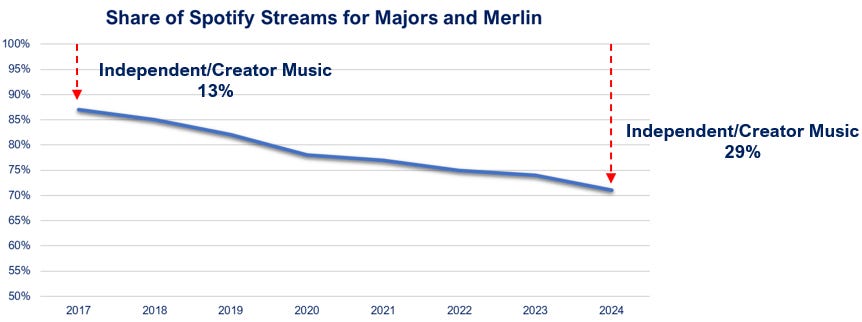
Source: Spotify.
Figure 2. YouTube—and Therefore Independent Creators—Now Accounts for 13% of Time Spent With TV in the U.S.
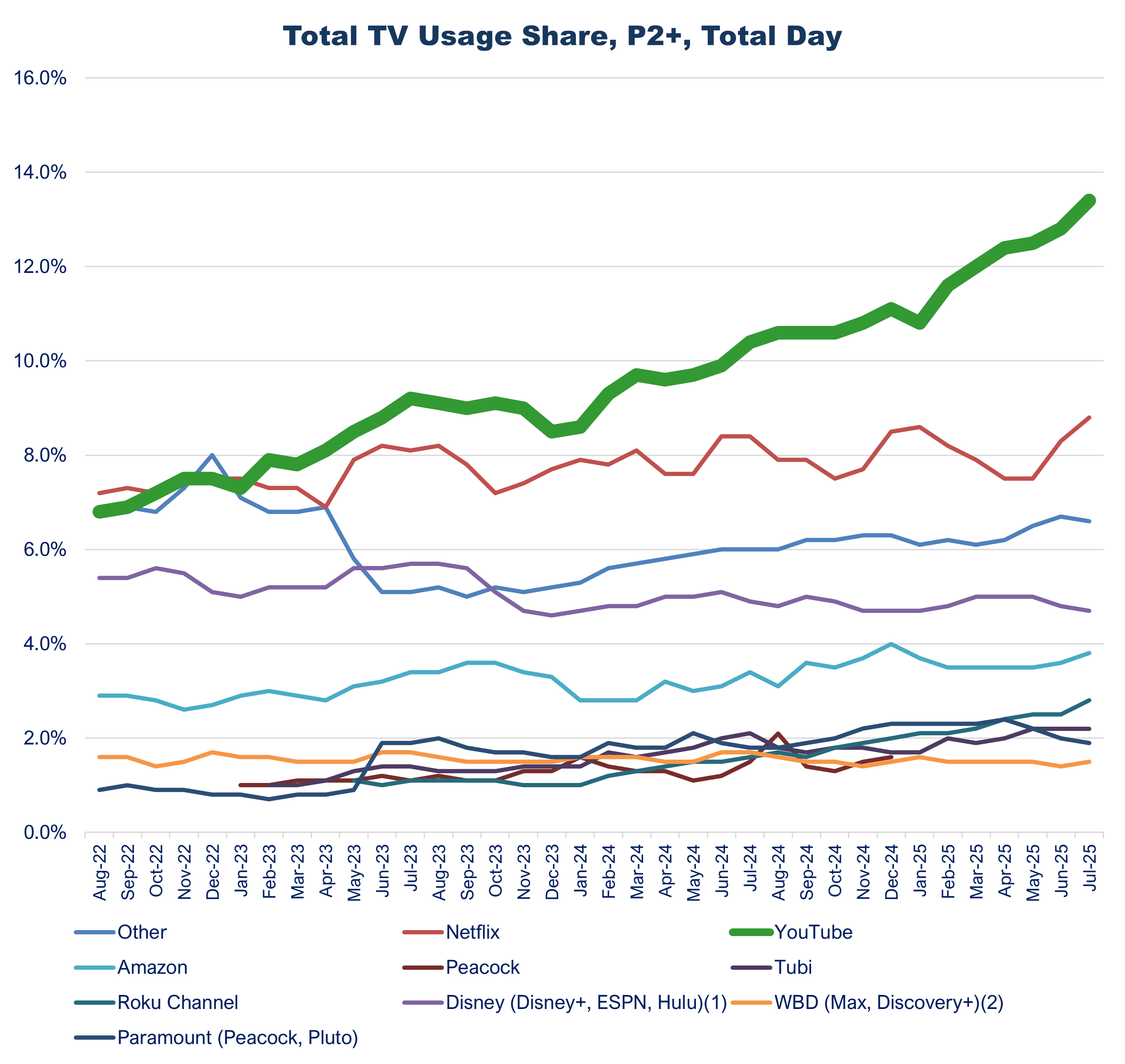
Note: (1) ESPN+ estimated prior to January 2025. (2) Discovery+ estimated prior to March 2025. Source: Nielsen, The Mediator estimates.
While the internet had an indirect effect on content creation businesses and media-specific technological developments have started to chip away at the barriers to content creation, GenAI will deliver a direct hit.
But these incursions into content creation are likely just a taste of what’s to come. Relative to the patchwork of format-specific technologies that has lowered barriers, GenAI represents a step change function that looks poised to collapse them. Of course, one major difference is that GenAI enables purely synthetic content. It is already feasible to build some sort of agentic content creation-distribution loop. The agent (or more likely several agents) scans the network for trending topics, creates content, seeds it out on the network, sees what works, develops more content, and so on. You could construct a content creation machine with no human involvement at all. Whether you want to is another story.
But even presuming that we will always need a “human in the loop” to make anything interesting, GenAI will dramatically reduce the barriers to creation for a few reasons:
GenAI is a general-purpose technology and will improve accordingly. GenAI is attracting unprecedented amounts of capital and brainpower. As everyone who tries to keep up with the latest developments in GenAI knows, that all but ensures a bewilderingly fast and compounding rate of improvement. By contrast, the latest improvements in media-specific technologies—like, say, video editing software—are pretty marginal.
It completely collapses learning curves. Media-specific production hardware and tools (DAWs, phone cameras, gaming engines) all made creation cheaper and more accessible, but they still have learning curves (music theory, editing workflows, coding) and require some threshold level of skill or craft. GenAI collapses these learning curves because it shifts the interface to natural language and simple prompts.
It solves the “blank page” problem. Traditional tools are still passive. They only do what you tell them. You still have to supply the vision and first draft. GenAI is active. It generates starting points, fills in gaps, and coaxes you along. It is a co-creator. That collapses arguably the toughest barrier of them all, the friction of starting.
It will diffuse into existing tools. Previous democratizing tools generally existed in siloes. You either learned the new tool or you didn’t. GenAI will be embedded in all other tools—Adobe’s editing suite, Avid, Unreal, Unity, CapCut, YouTube Studio, TikTok, Canva, etc. It will be a universal accelerant, regardless of how a creator creates.
So, while the internet had an indirect effect on content creation businesses and media-specific technological developments have started to chip away at the barriers to content creation, GenAI will deliver a direct hit. In other words, we ain’t seen nothing yet.
What will we see? Most content may cease to be a profit center.
Keep reading with a 7-day free trial
Subscribe to The Mediator to keep reading this post and get 7 days of free access to the full post archives.